
Understanding Subsurface Drip System Design for Row Crops
Understanding Subsurface Drip System Design for Row Crops
Water is the lifeblood of agriculture, but for modern row crop farmers, it is also a resource under immense pressure. Shrinking aquifers, regulated allocations, and unpredictable rainfall patterns are forcing the industry to rethink how water is applied to the field. Relying on traditional methods like flood irrigation or center pivots often results in significant water loss through evaporation and runoff.
To maintain profitability and yield stability, producers need a system that maximizes every drop. This is where Subsurface Drip Irrigation (SDI) is changing the landscape. Unlike overhead systems that spray water into the air, SDI works from the ground up—literally. By placing water exactly where the crop needs it, farmers can achieve unprecedented efficiency.
Implementing an SDI system is a significant investment that requires careful planning and precise design. When done correctly, however, it transforms farm management. As a trusted partner in irrigation system design and installation, Western Irrigation helps producers navigate this transition, ensuring that the move to SDI translates into long-term agricultural success.
What is Subsurface Drip Irrigation (SDI)?
Subsurface Drip Irrigation is a low-pressure, high-efficiency system that uses buried drip tapes or tubes to deliver water directly to the crop root zone. While surface drip lines sit on top of the soil, SDI is permanently installed below the tillage depth.
The concept is simple but powerful. Water is pumped through a network of valves and pipes into lateral driplines. Small outlets, known as emitters, are spaced along these lines to release water at a slow, controlled rate.
This method stands in stark contrast to traditional irrigation. Center pivots and linear moves spray water through the air, making them susceptible to wind drift and high evaporation rates, especially in arid climates. Flood irrigation relies on gravity and saturation, often leading to uneven distribution and nutrient leaching. SDI eliminates these issues by keeping the water underground, ensuring that the soil surface remains dry while the roots receive constant moisture.
Key Benefits of SDI for Row Crops
Switching to a subsurface system offers advantages that go beyond water conservation. It changes the agronomic potential of the field.
Water Conservation
The most immediate benefit is efficiency. SDI systems typically operate at 95% efficiency or higher. Because the water is applied underground, there is zero evaporation loss from wind or hot air. There is also no surface runoff, meaning the water you pump is the water the crop actually uses.
Improved Crop Yields
Consistency drives yield. SDI allows farmers to maintain a uniform soil moisture level, avoiding the “wet-dry” cycles common with flood or furrow irrigation. This reduces plant stress and promotes deeper, healthier root development.
Enhanced Nutrient Management
SDI is the perfect vehicle for fertigation—the process of injecting nutrients directly into the irrigation water. This allows for spoon-feeding crops with precise amounts of fertilizer exactly when they need it, right at the root zone. This reduces fertilizer waste and prevents nutrient runoff into local waterways.
Long-Term Cost Savings
While the initial installation cost is higher than some systems, the operational costs are often lower. Using less water means running pumps for fewer hours, which significantly cuts energy bills. Furthermore, because the soil surface stays dry, weed germination is reduced, lowering herbicide costs and labor.
Critical Components of an SDI System
An SDI system is more than just buried pipe. It is an engineered network of components that must work in harmony.
- Drip Tape/Lines: These are the heart of the system. For row crops, these are typically thin-walled tubes with integrated emitters. The wall thickness and emitter spacing depend on the lifespan of the system and the crop type.
- Emitters: These precision-molded devices control the flow rate. Pressure-compensating (PC) emitters are essential for fields with uneven terrain to ensure rows at the bottom of a hill don’t get more water than those at the top.
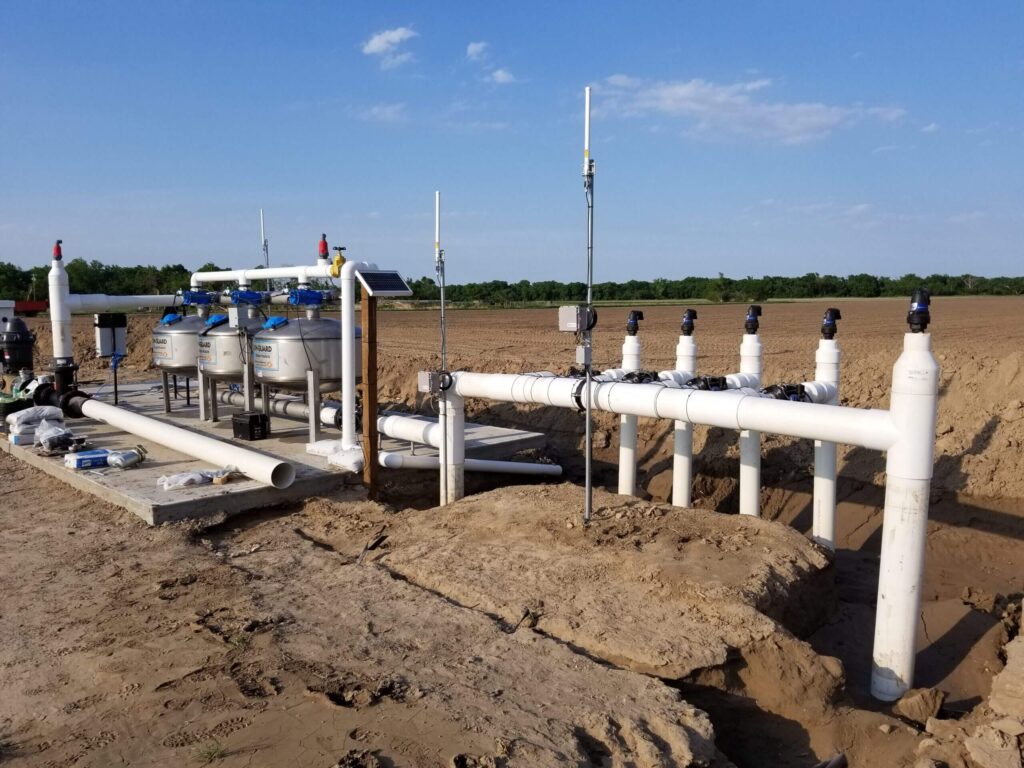
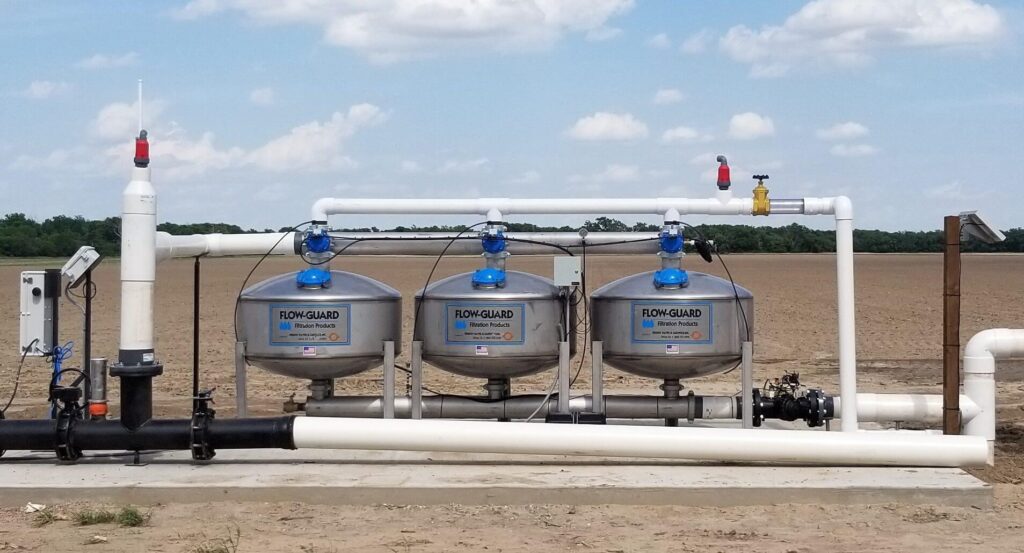
- Filtration System: This is the most critical component for system longevity. Because emitters have tiny pathways, even small particles can cause clogs. Sand media filters, disc filters, or screen filters are used to scrub the water before it enters the field.
- Pumps and Controllers: Efficient pumps move the water, while automated controllers manage the schedule. Modern controllers can even link to soil moisture sensors to irrigate automatically based on real-time field conditions.
Designing an SDI System: Factors to Consider
There is no “one size fits all” in subsurface irrigation. A successful design relies on a deep understanding of the specific field conditions.
Soil Type and Water Movement
Water moves differently in sand than it does in clay. In sandy soils, water tends to move straight down (gravitational flow), requiring closer drip line spacing to ensure lateral coverage. In clay soils, water moves outward (capillary action), allowing for wider spacing. A proper soil analysis is the first step in design.
Crop Type and Root Depth
The depth of the installation must match the crop. For deep-rooted row crops like corn or cotton, lines are typically buried 12 to 18 inches deep. This allows for surface tillage without damaging the tape while keeping water accessible to the roots.
Field Topography
The slope of the land dictates the hydraulic design. Significant elevation changes require careful pressure management. Engineers may design the system in zones or use pressure-compensating emitters to ensure that the pressure remains uniform across the entire block.
Hydraulic Design
The system must be balanced. If the pipes are too small, friction loss will reduce the flow at the end of the row. If they are too big, it increases costs unnecessarily. Calculating the correct flow rates and pressures ensures every plant gets the same amount of water.
Installation Best Practices for SDI
Even the best-designed system will fail if installed poorly. Precision is paramount during the installation phase.
Depth and Spacing Accuracy
The drip tape must be injected at a uniform depth across the field. If the depth varies, some plants may struggle to reach the water while others are over-saturated. GPS-guided installation equipment is standard practice to ensure lines are perfectly straight and spaced correctly relative to the crop rows.
Uniformity
The goal is high distribution uniformity. Installers must ensure that mainlines and sub-mains are properly bedded and that all connections are secure to prevent underground leaks that are difficult to detect later.
Professional Installation
Given the complexity and the underground nature of the infrastructure, professional installation is highly recommended. Errors made during burial—such as kinking the tape or stretching it—can be disastrous and expensive to fix.
Maintenance and Troubleshooting of SDI Systems
Because the system is buried, visual inspection is impossible. Therefore, a rigorous maintenance schedule is required to keep the system running smoothly for 15 to 20 years.
Regular Flushing
Over time, fine silt or biological growth can accumulate at the ends of the lines. Regular flushing of the mains and laterals pushes this debris out of the system.
Filter Maintenance
The filter station is the first line of defense. It must be checked and back-flushed regularly to ensure clean water is entering the drip tape.
Chemical Injection
To prevent root intrusion (roots growing into the emitters) or mineral scaling (calcium or iron buildup), periodic injection of acids or root inhibitors may be necessary.
Addressing Issues
Farmers should monitor flow meters and pressure gauges daily. A sudden drop in pressure might indicate a leak, while an increase could signal a clog. Western Irrigation provides ongoing support to help diagnose these hydraulic anomalies and recommend the right course of action.
Why Choose Western Irrigation for Your SDI Needs?
Transitioning to Subsurface Drip Irrigation is a significant decision that impacts both operational efficiency and crop productivity. It’s more than an equipment upgrade; it’s an investment in precision farming. That’s why choosing the right partner is crucial to ensuring long-term success and maximizing return on investment.
Western Irrigation brings unparalleled expertise in both agronomy and engineering, offering custom solutions tailored to your specific needs. From thoroughly analyzing soil conditions to designing systems aligned with your field’s topography, we ensure optimal performance. Our experience in managing crop diversity and rotation ensures that each system we install integrates seamlessly with your farming practices.
Beyond installation, Western Irrigation provides comprehensive support to ensure your system operates at peak efficiency. We conduct detailed initial soil analysis, precision equipment setup, and rigorous pressure testing to guarantee reliability. With Western Irrigation, you’re not just purchasing an SDI system; you’re partnering with experts dedicated to your farm’s success.
Secure Your Farm’s Future
Water scarcity is not going away, but your farm can remain resilient. Subsurface Drip Irrigation offers a pathway to higher yields with fewer resources, protecting your bottom line and the environment.
Ready to explore how SDI can work for your operation? Contact Western Irrigation today to schedule a consultation and take the first step toward a more efficient future.